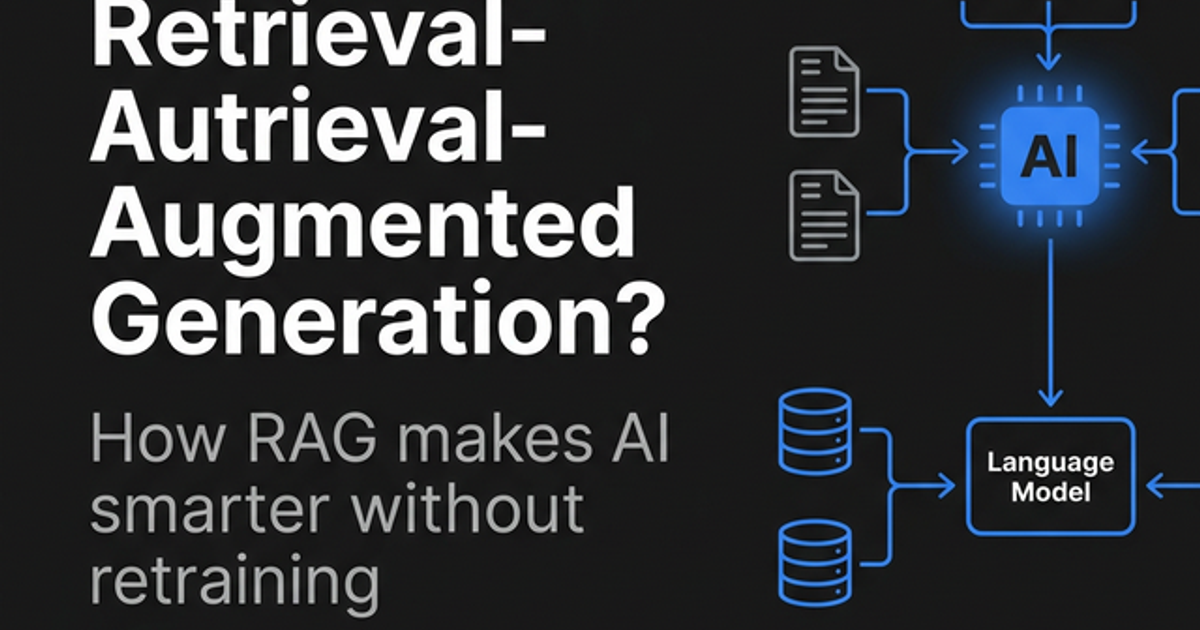
What Is Retrieval-Augmented Generation (RAG) and Why Does It Matter?
You’ve probably run into this problem: you paste a chapter of your company handbook into ChatGPT, ask it a question, and get a perfectly confident answer — that has nothing to do with what you just shared. Or you ask about something that happened last month and the model politely reminds you that its knowledge cuts off in the past.
This is the core limitation that cost early enterprise AI pilots millions of dollars in failed deployments: standard AI models don’t actually read your documents. They generate responses based on what they were trained on. If the answer isn’t in their training data, they’ll invent something plausible instead.
Retrieval-Augmented Generation — RAG, for short — is the architecture that fixes this. It’s not a new model. It’s not a product. It’s a design pattern that plugs a real knowledge source into an AI’s response pipeline. And once you understand how it works, you’ll see it operating behind almost every useful enterprise AI application built today.
Section 1: The Problem RAG Is Solving
To understand why RAG matters, you first need to understand what standard language models cannot do — and why.
Every LLM has a knowledge cutoff: a date after which it has no information, because its training data ended there. Ask GPT-4 about a merger that closed six months ago, or Claude about a regulatory update published last quarter, and it simply doesn’t know. This isn’t a bug. It’s an architectural consequence of how these models are built. Training is expensive and infrequent; knowledge cutoffs are unavoidable.
But the problem runs deeper than dates. Even when information is technically available — say, you paste the relevant document directly into the conversation — LLMs struggle with long contexts in ways that aren’t obvious. A phenomenon researchers call the “lost in the middle” problem has been validated across GPT-4, Claude, and Llama: models tend to pay disproportionate attention to content at the beginning and end of a prompt, and systematically underweight material buried in the middle. In a 100-page document pasted as context, the answer sitting on page 47 has a reasonable chance of being missed or misweighted — even if it’s the most relevant passage in the entire document.
The brute-force workaround — feeding your entire document library into the prompt every time — fails on multiple fronts. Modern context windows are large but not unlimited. At scale, sending thousands of tokens per query is expensive. And latency compounds: longer prompts take longer to process. Running this architecture against a 50,000-page knowledge base isn’t a design; it’s a timeout.
The underlying mismatch is architectural. LLMs are trained to generate, not to retrieve. Their strength is synthesizing patterns into fluid, coherent language. Their weakness is pinpointing specific facts within a large body of documents they haven’t indexed. Asking a language model to also function as a reliable search engine is asking a chef to also be a librarian.
Consider a concrete case: a law firm rolls out an AI assistant on its internal case archive — tens of thousands of pages of case files, briefs, and memos. Instead of a true retrieval layer, the implementation simply pastes whatever documents the attorney uploads into the context. The model confidently cites case precedents that don’t exist. It conflates details across cases pasted in the same session. Within weeks, an attorney includes an AI-generated citation in a filing that a judge flags as fabricated. The tool is quietly decommissioned.
The lesson isn’t that AI can’t be used in legal work. The lesson is that adding documents to a prompt is not the same as making AI understand your documents. RAG is the architecture that makes the latter possible.
Section 2: How RAG Works (The Non-Technical Explanation)
The most useful analogy for RAG is this: imagine a brilliant analyst who has access to a well-organized filing cabinet.
Without the filing cabinet, the analyst can only answer from memory — which is impressive but finite and sometimes wrong. With the filing cabinet and the ability to search it efficiently, she retrieves exactly the relevant pages before responding, and her answer is both grounded in the actual source material and citable.
RAG gives AI that filing cabinet. Here’s how the pipeline works in three steps.
Step 1: Index
Before any questions are asked, your documents go through a preparation phase. Each document is broken into chunks — paragraphs, sections, or sliding windows of text — and each chunk is converted into a vector embedding: a numerical representation of its meaning, stored in a specialized database called a vector store.
Think of vector embeddings as coordinates on a map where meaning, not geography, determines proximity. The chunk “the quarterly earnings declined by 12%” and the chunk “revenue dropped significantly in Q3” will have similar coordinates — not because they share the same words, but because they carry similar meaning. This spatial representation of semantics is what makes the next step possible.
Step 2: Retrieve
When a user submits a query — say, “What were the main risks management flagged in Q3?” — the system doesn’t search for those exact words. Instead, it converts the query into its own embedding and searches the vector store for the chunks whose coordinates are closest to the query’s coordinates. This is semantic search: finding relevant content by meaning rather than keyword.
The difference from traditional search is significant. A keyword search for “Q3 risk” will find documents containing those terms. A semantic search will also find documents that discuss “third-quarter uncertainty,” “Q3 headwinds,” or “concerns management raised in the July earnings call” — because they occupy similar regions of the meaning space.
Step 3: Generate
The retrieved chunks — typically the top three to ten most relevant passages — are passed to the language model as context, alongside the original question. The model is instructed to answer based on what it’s been given. This is the grounding step: the response is anchored to specific, retrieved source material rather than the model’s general training memory.
The result is an answer that cites real passages from your documents, stays within the boundaries of what was retrieved, and responds “I don’t have information on that in the provided documents” when the relevant content isn’t present — rather than inventing something plausible.
Schematically:
[Your Documents]
       ↓
[Embedding Model → Vector Database]
       ↓
[User Query → Semantic Search → Retrieved Chunks]
       ↓
[LLM + Retrieved Chunks as Context]
       ↓
[Grounded, Citable Answer]
Section 3: RAG vs. Fine-Tuning — Which One Do You Actually Need?
When teams first explore customizing AI for their specific domain, two approaches come up: RAG and fine-tuning. They address fundamentally different problems, and the confusion between them is responsible for a significant amount of wasted engineering time and budget.
| RAG | Fine-Tuning | |
|---|---|---|
| Best for | Accessing specific documents and data | Changing how the model behaves or speaks |
| Knowledge updates | Add documents anytime, re-index | Requires a new training run |
| Hallucination risk | Lower (grounded in retrieved content) | Higher (knowledge baked into weights) |
| Cost | Moderate (inference + retrieval at runtime) | High upfront (GPU training costs) |
| When to use | ”Answer using this data" | "Always respond this way” |
Fine-tuning modifies the model’s underlying weights through additional training. It changes how the model reasons, communicates, and behaves. If you want a customer-facing model that always responds in your brand’s tone, declines certain topic categories, or has internalized domain-specific formatting conventions — fine-tuning addresses those goals. But it bakes knowledge into fixed weights: whatever the model learns during fine-tuning is frozen until you retrain.
RAG doesn’t touch the model’s weights at all. It changes what the model sees at inference time, by supplying it with retrieved, relevant context. Your knowledge source stays external, queryable, and updatable at any time without touching the AI model itself.
Most enterprise use cases that teams initially frame as fine-tuning problems — “we want AI to know our product documentation,” “we need it to reference our internal policies” — are actually RAG problems. Fine-tuning is the right tool when you need to change how the model behaves. RAG is the right tool when you need it to know specific things.
They’re also not mutually exclusive. A model can be fine-tuned for communication style and domain-specific reasoning, then paired with a RAG layer that gives it access to live, proprietary data. This combination is increasingly the architecture of choice for serious enterprise deployments.
Section 4: Real-World RAG in Action
RAG isn’t a research concept waiting for production-readiness. It’s already operating at scale across multiple industries. The patterns are worth studying, because they reveal both what the technology can do and how teams are actually deploying it.
Customer support: Traditional AI chatbots were brittle — their answers depended on what they were trained on, which became stale the moment documentation changed. With RAG, the chatbot retrieves from live product documentation at query time. When policies are updated, the vector index is updated. No retraining cycle, no deployment pipeline for knowledge changes. A SaaS company that previously needed a human review step on every AI-generated support response can shift that review to an exception-handling workflow.
Legal and institutional knowledge: Law firms and consulting agencies are deploying RAG systems over their institutional archives. An attorney querying 20 years of internal memos gets an answer that cites the specific documents it drew from — not a plausible synthesis that might conflate two separate matters. The citation trail is what makes this usable in a professional context: the attorney can verify the source before relying on the output.
Financial research: Quantitative investors and research teams use RAG over earnings transcripts, regulatory filings, and internal models. Rather than manually reading through hundreds of quarterly calls to track how management characterizes supply chain risk over time, an analyst can query the corpus directly and receive structured, sourced answers. The retrieval step transforms months of reading into minutes of querying.
Personal productivity tools: Google’s NotebookLM is, at its core, a consumer-grade RAG interface. Upload a set of PDFs — a book, a research paper, a business plan — and conduct a cited conversation with the content. The model answers from the documents you’ve uploaded, tells you which passages it drew from, and explicitly declines to answer from general knowledge when the information isn’t in your materials.
The common thread across these cases is the citation advantage: well-implemented RAG doesn’t just return an answer, it returns the answer alongside the source passages that generated it. This transforms AI from a fluent guesser into an auditable research tool — a fundamentally different product, and one that earns a fundamentally different level of trust.
Section 5: The Limitations — What RAG Doesn’t Fix
Honest assessment of RAG requires acknowledging where it falls short, because production teams that treat it as a complete solution reliably discover these limitations at the worst possible time.
Retrieval quality is the ceiling. The quality of a RAG system’s output cannot exceed the quality of its retrieval step. If the semantic search returns the wrong chunks — because the query is ambiguous, the document structure is poor, or the chunking strategy is misaligned with how queries are phrased — the model will generate a response grounded in irrelevant content. This failure mode is particularly insidious because the output will look confident and well-structured, even when it’s responding to the wrong source material.
Chunking decisions have cascading effects. How you split documents into chunks is one of the most consequential decisions in a RAG implementation, and it receives far less attention than model selection. A chunk boundary in the wrong place destroys context. The sentence “the rate is 5%” is meaningless without knowing whether the preceding sentence said “the tax rate,” “the interest rate,” or “the error rate.” Naive fixed-length chunking — splitting every 500 tokens regardless of sentence or paragraph boundaries — produces retrieval artifacts that degrade answer quality in ways that are difficult to diagnose.
Latency is a real constraint. Adding a retrieval step — converting the query to an embedding, searching the vector store, fetching top-k chunks, constructing the prompt — takes time. For low-latency applications (real-time voice assistants, live customer interactions with strict SLA requirements), the overhead matters. Architectural choices like approximate nearest-neighbor search and caching strategies exist to mitigate this, but they require deliberate design.
Cross-document synthesis is a weak point. RAG excels at finding relevant passages and grounding answers in them. It’s substantially weaker when the answer requires synthesizing patterns across hundreds of documents simultaneously — for example, “how has customer sentiment toward our pricing model evolved across all support tickets from the past two years?” This type of longitudinal, aggregated reasoning typically requires purpose-built analytics pipelines, not a retrieval-generate loop.
Evaluation at scale is non-trivial. Knowing whether your RAG system is actually performing well — not just on the handful of queries you manually tested, but across the full distribution of queries your users will ask — requires dedicated evaluation infrastructure. Standard approaches include RAGAS (a framework for RAG evaluation metrics) and human-in-the-loop review pipelines. Teams that skip this step tend to ship systems that work in demo conditions and degrade in production.
The practical implication: RAG significantly reduces hallucination and grounds AI responses in actual source content. It does not eliminate hallucination. The model can still misinterpret retrieved content. Build verification and citation-checking into your workflow, not as an afterthought.
Section 6: Should You Build Your Own RAG System?
The barrier to experimenting with RAG has dropped substantially. Depending on your requirements, you may not need to build anything at all.
Start with off-the-shelf tools
NotebookLM (Google) — The most accessible entry point. Upload PDFs, documents, or web URLs. Ask questions. Receive answers with cited passages. Free. No technical setup. Ideal for individual research, summarization, and document Q&A.
Perplexity AI — RAG over the live web. Useful for current events research where you need sourced, up-to-date answers rather than responses from a fixed training corpus.
ChatGPT with file uploads — Basic document Q&A over uploaded files. Less rigorous about citations than NotebookLM, but accessible and integrated into an already-familiar interface.
Build your own (when you need control)
When off-the-shelf tools are insufficient — because of data privacy requirements, the need for custom retrieval logic, organizational scale, or proprietary datasets — building a RAG pipeline becomes the right choice.
A standard open-source RAG stack looks like this:
- Embedding model: OpenAI’s
text-embedding-3-large, Cohere’sembed-v3, or local models likenomic-embed-textfor privacy-sensitive workloads. - Vector database: Pinecone (managed, scalable), Chroma (local, easy to set up), or pgvector (if you’re already running PostgreSQL).
- LLM: Claude, GPT-4o, or an open-source model like Llama running locally.
- Orchestration framework: LangChain or LlamaIndex handle the plumbing — chunking, embedding, retrieval, prompt construction — so you don’t build the pipeline from scratch.
Before committing to a stack, the LLM Cost Calculator is a practical tool for estimating the combined cost of embedding generation and inference at your expected query volume. The cost equation changes significantly depending on whether you choose a managed embedding API or run embeddings locally.
The key decision question: Do I need AI to answer questions grounded in specific, controlled documents that change over time? If yes, RAG is the right architecture. If the requirement is about changing how the model reasons or communicates, fine-tuning is the relevant tool. If you’re working with sensitive images or files where local processing matters, tools like PrivaLens address the privacy dimension of that workflow.
Final Thoughts
The reason RAG matters in 2026 is not theoretical. It’s the difference between an AI system that makes things up and one that can actually be trusted with institutional knowledge.
Standard LLMs are trained on the past. Your business, your documents, your operational reality exist in the present. RAG is the bridge — a way to give AI a live, grounded, auditable connection to the specific knowledge it actually needs for your context. It doesn’t make AI omniscient. It makes AI accurate within a defined domain, which is a more useful property.
You don’t need to build a RAG system today to benefit from understanding it. The next time a vendor demos an “AI solution for your internal knowledge,” you’ll know which questions to ask: How is the retrieval layer implemented? What chunking strategy is being used? How are citations surfaced? How is performance evaluated at scale?
And if you’re ready to experiment — the barrier is lower than you think. Upload five documents to NotebookLM this week. Ask it something you’d normally have to search for manually. That’s RAG, in its simplest consumer form, working for you right now.
Related reading:
- The Honest Beginner’s Guide to AI: Skip the Hype, Start Here
- LLM Cost Calculator — Compare embedding and inference costs before committing to a RAG stack